Boards in humid environments: Which one withstands moisture better?
September 11 , 2026
In the manufacture of furniture and interior design for spaces exposed to moisture, such as kitchens, bathrooms, commercial facilities or coastal areas, the board’s behaviour when exposed to water affects the stability and service life of the finished product.
Not all wood-based panels respond to moisture in the same way. Density, the manufacturing process and the board’s structure determine its water absorption capacity and its behaviour when exposed to moisture.
Hardboard vs. MDF: what happens when they come into contact with water?
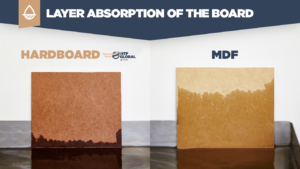
Absorption tests show differences between the two materials:
Water absorption
In MDF, its fibre structure and lower density, generally between 600 and 750 kg/m³, favour water penetration through capillary action. Moisture can move into the board and cause the fibres to expand.
Hardboard, with densities above 900 kg/m³, has a more compact structure that makes water penetration more difficult.
Swelling and dimensional stability
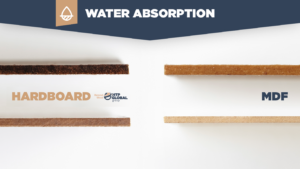
Water absorption can cause changes in the thickness of the board. In components such as drawer bottoms, back panels, wall coverings or panels, significant swelling can affect the fit of the pieces and assembly systems.
MDF can experience greater thickness swelling after exposure to water. Hardboard offers greater dimensional stability and limits these variations.
Why does Hardboard offer greater resistance to moisture?
Hardboard’s high density and manufacturing process have a direct influence on its behaviour when exposed to moisture.
During the wet process, wood fibres are compressed at high temperatures until densities above 900 kg/m³ are reached. The wood’s natural lignin acts as a binder, without the need to add glues or synthetic resins.
The board’s compact structure limits water penetration and reduces the thickness variations that can occur after exposure to moisture.
Which board should you choose depending on the application?
The choice depends on the conditions to which the board will be exposed:
- Ambient humidity: Hardboard can be used in interior applications where there is moderate exposure to changes in humidity.
- Moisture and temperature variations: HTP Tempered Premium offers greater moisture resistance and is suitable for Service Class 2. Its treatment improves water repellency while maintaining high mechanical strength.
- Condensation and risk of fungal growth: HTP Antimould+ incorporates a preservative treatment that provides protection against fungi that deteriorate wood.
- Direct or continuous exposure to water: the specific conditions of the application must be assessed and the product’s technical specifications should be consulted.
Need help choosing the right board for an application exposed to moisture?
Contact the HTP Global Group technical team to find out more about our solutions and identify the most suitable board for your project.