How to comply with Regulation (EU) 2023/1464 on formaldehyde?
September 4 , 2026
Since 6 August 2026, the new formaldehyde emission limits established by Regulation (EU) 2023/1464 have applied to certain articles placed on the European Union market.
Having previously analysed what this change means for the industry, we now take it one step further: what should manufacturers do to ensure that their products comply with the new requirements?
The answer lies in understanding the materials used, controlling potential sources of emissions and verifying product performance through the testing methods established by the Regulation.
What does a manufacturer need to do to comply?
The first step is to determine whether the product falls within the scope of Entry 77 of Annex XVII to the REACH Regulation.
For furniture and wood-based articles, the maximum emission limit is 0.062 mg/m³, while a limit of 0.080 mg/m³ applies to other articles covered by the restriction.
From there, it is important to:
- Identify the materials that make up the product and potential sources of formaldehyde emissions.
- Review the technical information provided by suppliers.
- Verify product emissions where necessary, following the conditions established by the Regulation.
- Keep test results and technical documentation that can demonstrate compliance.
Compliance starts with the choice of materials
For wood-based products, the choice of raw materials can make an important difference. Certain adhesives and synthetic resins used in the manufacture of wood panels can contribute to formaldehyde emissions from the finished product.
For this reason, choosing low-emission materials from the outset can help reduce risk and facilitate compliance with the new requirements.
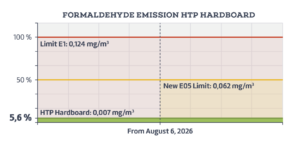
One example is HTP Global Hardboard, manufactured using a wet process that relies on the wood’s natural lignin as a binder, without adding synthetic adhesives or resins.
Tests carried out on the material have recorded formaldehyde emissions of 0.007 mg/m³, well below the 0.062 mg/m³l imit established for furniture and wood-based articles.
How are formaldehyde emissions tested?
The Regulation establishes reference conditions for determining the concentration of formaldehyde released by an article.
The measurement is carried out in a test chamber, where the environment is controlled and the concentration released by the product is analysed until a steady state is reached.
The resulting value is then compared with the limit applicable to each product category. This allows manufacturers to determine whether emissions remain within the levels established by the legislation.
What happens if a product exceeds the limit?
If an article subject to the restriction exceeds the established emission limit, the manufacturer must identify the source of the problem and take the necessary measures before placing it on the market under conditions prohibited by the Regulation.
Possible actions include:
- Replacing materials or components with higher emissions.
- Reviewing adhesives or bonding systems.
- Modifying certain manufacturing process parameters.
- Re-testing emissions after introducing the changes.
Choosing the right materials and controlling the process from the outset can help avoid subsequent modifications and facilitate compliance with the new requirements.
Do you need to adapt your products to the new European formaldehyde emission limits?
Contact the HTP Global Group technical team to learn more about our Hardboard solutions and find the most suitable alternative for your manufacturing needs.